Classic
The 8 carpals, in the order of the list
Some Lovers Try Positions That They Can’t Handle: scaphoid, lunate, triquetrum, pisiform, trapezium, trapezoid, capitate, hamate. Proximal row first, each row from the thumb side.
27 bones · 12 answers · about 2 min · type the name · free
Last reviewed by Type Anatomy · BodyParts3D, CC BY 4.0 (modified)
Start typing · The name is shown: type over it.Tap here to type
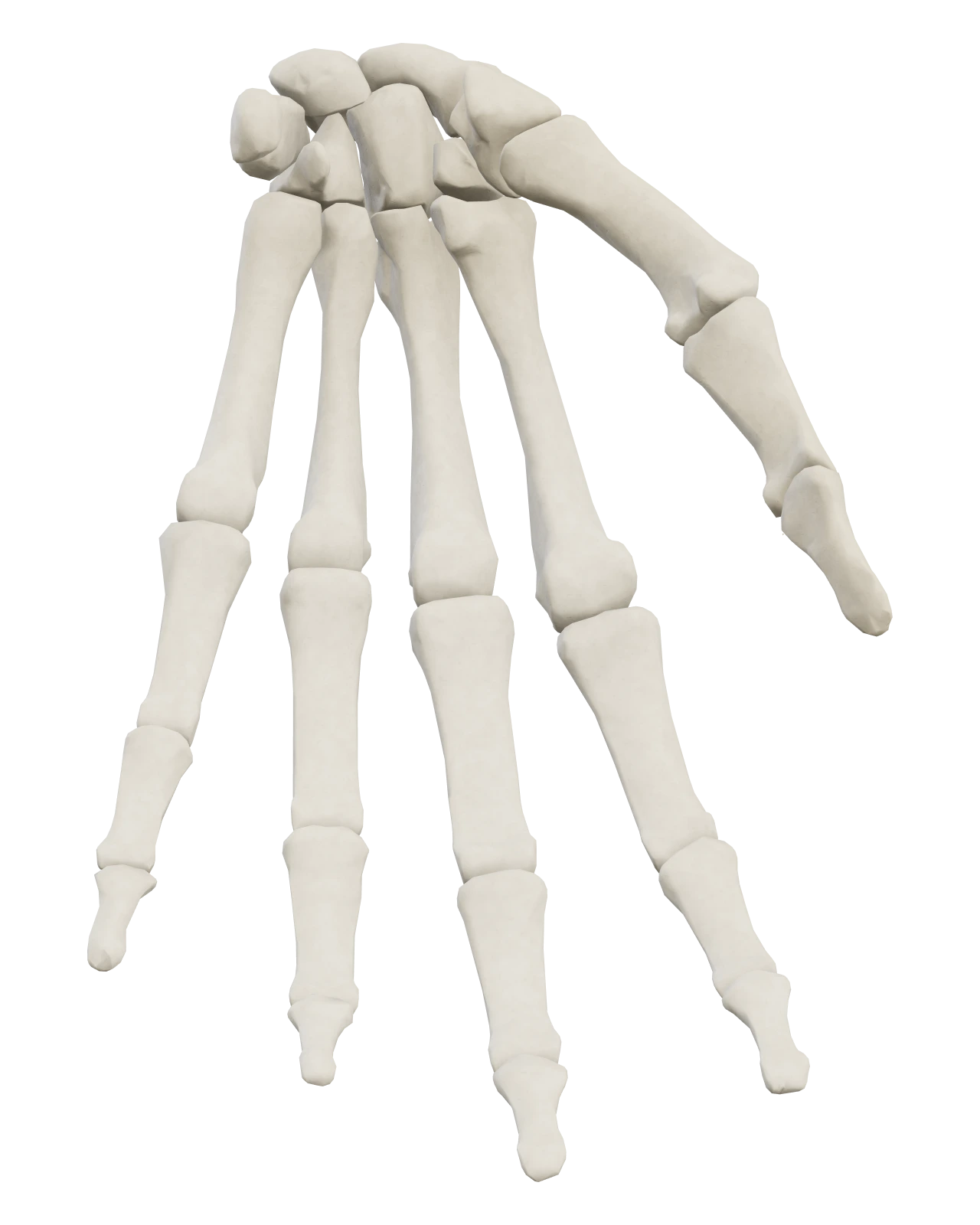
Each hand has 27 bones: 8 carpals in the wrist, in two rows of four; 5 metacarpals in the palm; and 14 phalanges in the fingers, 3 in each finger and 2 in the thumb. The proximal row, from the thumb side to the little-finger side, is scaphoid, lunate, triquetrum and pisiform; the distal row is trapezium, trapezoid, capitate and hamate.
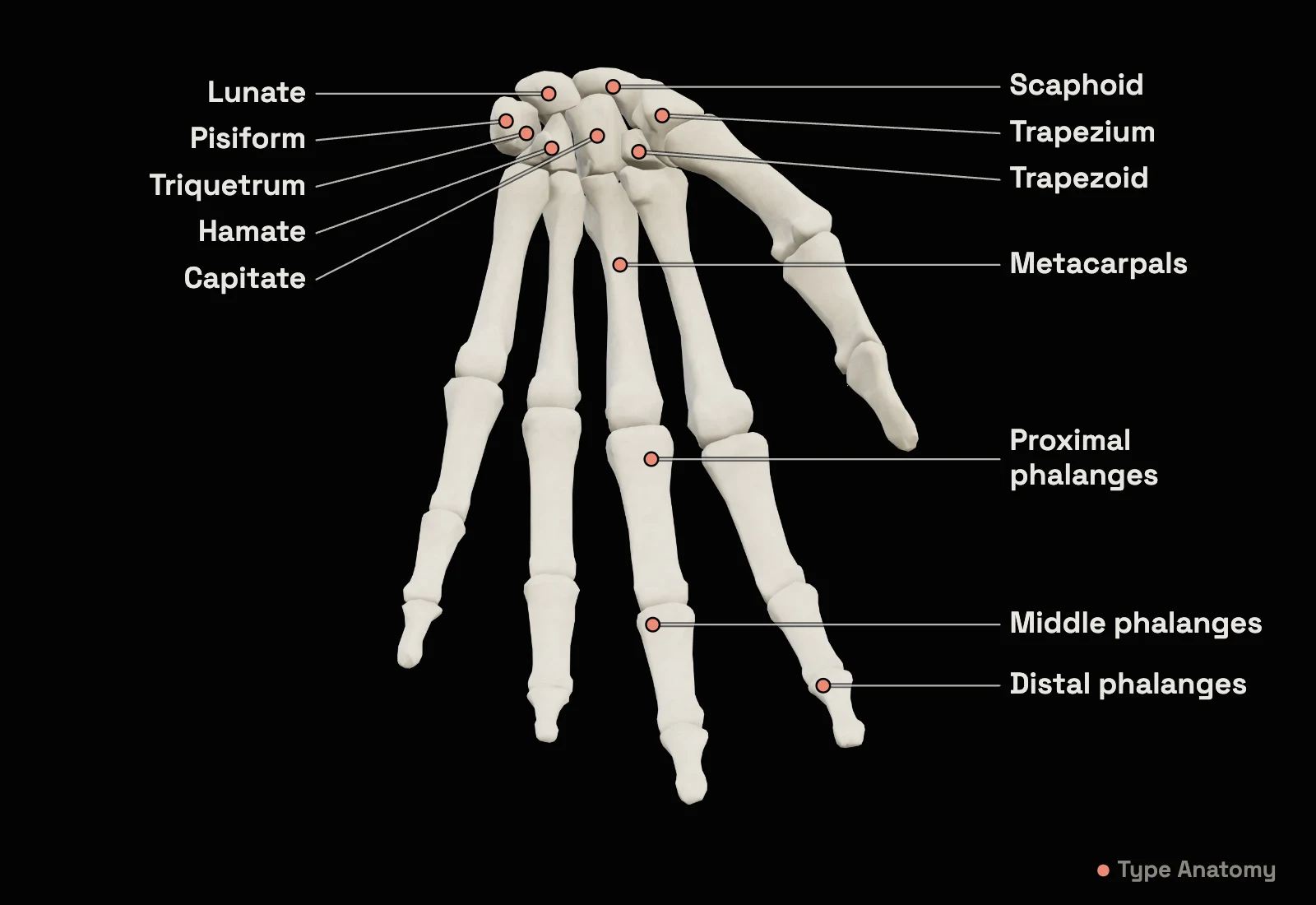
Left hand, palmar view: the palm faces you and the thumb is on your right.
The quiz has 12 answers for 27 bones: each of the 8 carpals is its own answer, while the 5 metacarpals and each row of phalanges (5 proximal, 4 middle, 5 distal) are asked as one. The model is a left hand.
| # | Name | Group | Where it is | How many |
|---|---|---|---|---|
| 1 | Scaphoid scaphoid bone, carpal navicular | Carpals, proximal row | Largest bone of the proximal row, on the thumb side; it breaks in falls on the hand. | 1 |
| 2 | Lunate lunate bone, semilunar | Carpals, proximal row | In the middle of the proximal row, between the scaphoid and the triquetrum. | 1 |
| 3 | Triquetrum triquetral, triquetral bone | Carpals, proximal row | Proximal row, little-finger side; the pisiform rests on its palmar face. | 1 |
| 4 | Pisiform pisiform bone, os pisiforme | Carpals, proximal row | Small sesamoid on the palmar side; the bump you feel at the wrist below the little finger. | 1 |
| 5 | Trapezium trapezium bone, greater multangular | Carpals, distal row | Distal row, at the base of the thumb; its saddle-shaped surface lets the thumb oppose. | 1 |
| 6 | Trapezoid trapezoid bone, lesser multangular | Carpals, distal row | Smallest of the distal row; it articulates with the index finger’s metacarpal. | 1 |
| 7 | Capitate capitate bone, os capitatum | Carpals, distal row | Center of the distal row, in line with the middle finger; its rounded top fits into the lunate. | 1 |
| 8 | Hamate hamate bone, unciform | Carpals, distal row | Distal row, little-finger side; its curved process borders the carpal tunnel. | 1 |
| 9 | Metacarpals metacarpal, metacarpal bones | Metacarpals | The five long bones of the palm, between the wrist and the fingers. | 5 |
| 10 | Proximal phalanges proximal phalanx, first phalanges | Phalanges | The row in each finger that meets the head of its metacarpal. | 5 |
| 11 | Middle phalanges middle phalanx, intermediate phalanges | Phalanges | One per finger, between the other two rows of phalanges; the thumb, with only two, has none. | 4 |
| 12 | Distal phalanges distal phalanx, terminal phalanges | Phalanges | The fingertips; their flared end supports the nail. | 5 |
| Total | 27 |
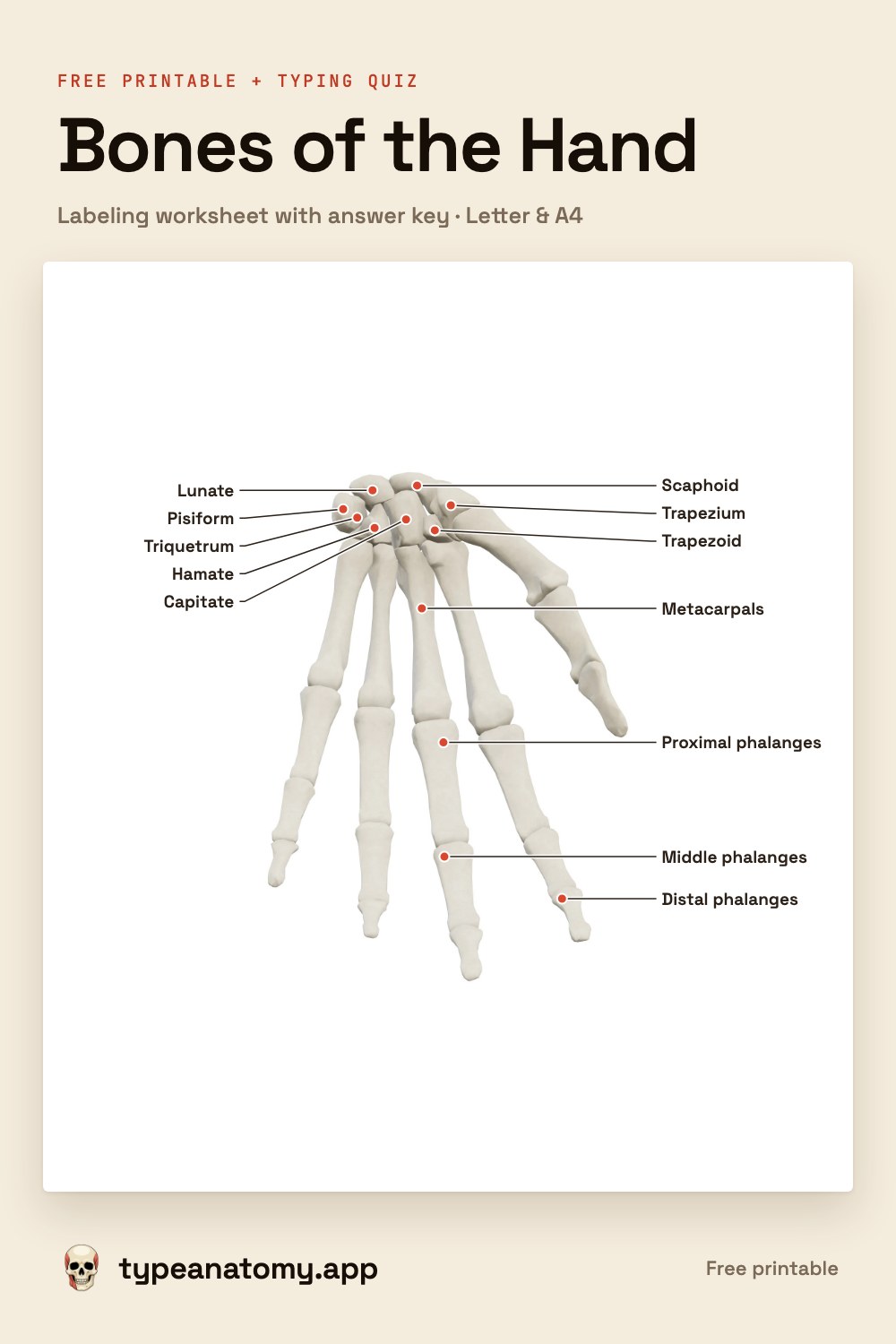
Download our labeling worksheet as a PDF, completely free. It comes with a word bank version, a blank version and the answer key.
Classic
Some Lovers Try Positions That They Can’t Handle: scaphoid, lunate, triquetrum, pisiform, trapezium, trapezoid, capitate, hamate. Proximal row first, each row from the thumb side.
Classic
So Long To Pinky, Here Comes The Thumb: the proximal row from the thumb to the pinky, then the distal row back from the pinky (hamate, capitate, trapezoid, trapezium). It’s the one OpenStax uses.
Trapezium or trapezoid? The trapezium sits under the thumb and gives it its saddle joint; the trapezoid is smaller and sits next to it, under the index finger.
Find them on your own wrist. The pisiform is the hard bump at the base of the palm on the little-finger side, and the hamate lies deep, about 2 cm from it toward the index finger. The scaphoid sits at the bottom of the anatomical snuffbox, the hollow at the base of the thumb when you stretch it out: pain there after a fall means a scaphoid fracture must be ruled out.
Lab practicals often show the back of the hand or a single loose bone. From the dorsal side the pisiform hides behind the triquetrum, so practice that view in the 3D version too.
27 in each hand: 8 carpals, 5 metacarpals and 14 phalanges, so 54 in both hands. Small sesamoid bones, like the pair at the thumb’s metacarpophalangeal joint (palmar to the head of the 1st metacarpal), vary from person to person and aren’t counted.
The 8 carpals are the short bones of the wrist, in two rows. The 5 metacarpals are the long bones of the palm, numbered 1 (thumb) to 5 (little finger); their heads are your knuckles.
The scaphoid, usually from a fall on an outstretched hand. It can pass for a sprain and first X-rays may look normal; because its blood supply is poor it heals slowly and can undergo necrosis.
Eight: the carpals. The radius and ulna reach the wrist, but they are forearm bones and aren’t part of the hand’s 27.
Yes. The quiz on this page is free and works on phone and computer, and so are the printable worksheets. The 3D version, where you turn the model yourself, is a paid app, with a free demo so you can try it before you pay.
The same names on a 3D model you can turn: it lights up, you type, and you review what you miss with spaced repetition.
Open the 3D game